Axial pressure acts as a critical mechanical driving force that supplements thermal energy during the sintering process. By applying continuous pressure (typically around 35 MPa), you actively promote plastic flow and particle diffusion, which allows Lithium Niobate to densify at significantly lower temperatures than would be required using heat alone.
The application of axial pressure effectively decouples densification from grain growth. By mechanically forcing particle rearrangement and diffusion, you can achieve near-theoretical density while maintaining a fine grain structure, avoiding the abnormal grain growth often associated with purely thermal sintering.
How Axial Pressure Drives Microstructure
Facilitating Plastic Flow
In standard sintering, particles fuse primarily due to surface energy reduction at high heat. With vacuum hot pressing, the 35 MPa of axial pressure introduces a mechanical stress that forces the ceramic particles to deform.
This facilitates plastic flow, allowing particles to reshape and slide past one another to fill void spaces more efficiently.
Enhancing Particle Diffusion
The applied pressure physically forces particles into closer contact, significantly reducing the diffusion distance required for bonding.
This mechanical proximity accelerates the atomic diffusion rate between ceramic particles, speeding up the overall consolidation process.
Thermal Management and Grain Stability
Lowering Required Temperatures
Because axial pressure provides a mechanical driving force for densification, the thermal energy required to fuse the material is reduced.
This allows the Lithium Niobate to reach high density at lower sintering temperatures compared to pressureless sintering methods.
Inhibiting Abnormal Grain Growth
One of the primary risks in ceramic processing is "abnormal grain growth," where grains grow excessively large and degrade mechanical or optical properties.
By sintering at lower temperatures—enabled by the axial pressure—you suppress the thermal kinetics that drive this uncontrolled growth, resulting in a finer, more uniform microstructure.
Eliminating Internal Defects
Mechanism of Pore Removal
Axial pressure does not just compact the powder; it actively squeezes out internal porosity.
The continuous force helps eliminate the voids and pores that typically become trapped between particles, which is essential for achieving high material density.
The Role of the Vacuum Environment
While pressure handles physical compaction, the vacuum environment works in tandem to ensure trapped gases are evacuated.
This prevents gas pockets from opposing the axial pressure, ensuring that the physical bonding induced by the pressure results in a solid, non-porous ceramic body.
Understanding the Trade-offs
Equipment Complexity vs. Material Quality
The primary trade-off is the shift from a simple thermal process to a complex thermo-mechanical one.
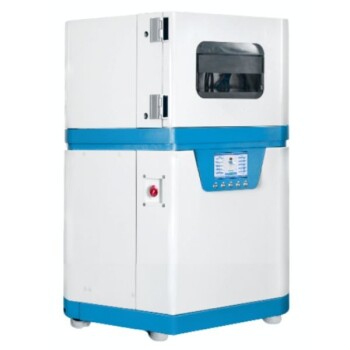
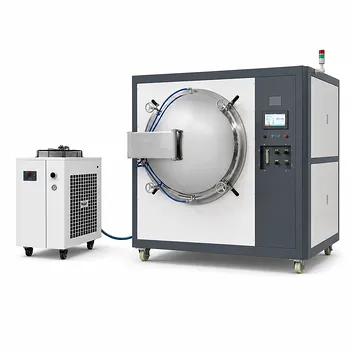
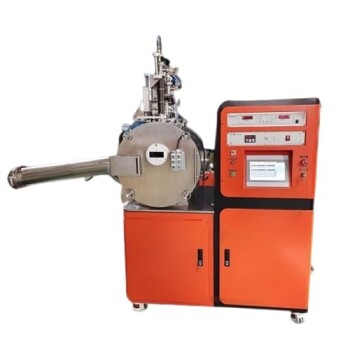
Achieving these results requires specialized vacuum hot pressing equipment capable of maintaining precise force (35 MPa) and vacuum simultaneously at high heat. This increases the cost and complexity of the operation compared to standard pressureless sintering, but is necessary when high density and fine grain size are non-negotiable.
Making the Right Choice for Your Goal
To determine if axial pressure is critical for your Lithium Niobate application, consider your specific performance metrics:
- If your primary focus is Optical Quality and Transparency: Axial pressure is essential to eliminate internal pores that scatter light, maximizing material density.
- If your primary focus is Mechanical Strength: The inhibition of abnormal grain growth provided by pressure-assisted sintering is vital for maintaining fracture toughness.
By utilizing axial pressure to drive plastic flow, you achieve a dense, high-performance ceramic without the structural degradation caused by excessive heat.
Summary Table:
| Mechanism | Impact on Lithium Niobate Sintering | Key Benefit |
|---|---|---|
| Plastic Flow | Forceful rearrangement and deformation of particles | Fills voids efficiently |
| Particle Diffusion | Reduces distance between particles under 35 MPa | Faster consolidation at lower heat |
| Thermal Kinetics | Enables lower sintering temperatures | Suppresses abnormal grain growth |
| Pore Removal | Actively squeezes out internal porosity | Achieves near-theoretical density |
| Vacuum Synergy | Evacuates trapped gases during compression | Ensures a solid, non-porous body |
Elevate Your Material Research with KINTEK
Precision in pressure and temperature is the key to unlocking the full potential of Lithium Niobate ceramics. KINTEK specializes in advanced laboratory equipment, offering state-of-the-art vacuum hot pressing systems and isostatic hydraulic presses designed to deliver the exact mechanical driving force your materials require.
Whether you are focusing on optical transparency or mechanical toughness, our comprehensive portfolio—including high-temperature furnaces (vacuum, tube, muffle), crushing and milling systems, and essential ceramic consumables—ensures your lab has the tools to achieve superior grain stability and density.
Ready to optimize your sintering process? Contact our technical experts today to find the perfect solution for your high-performance material needs.
関連製品
- 9MPa空気圧焼結炉(真空熱処理付)
- 高温用途向け真空熱処理・熱圧焼結炉
- 熱処理・焼結用600T真空誘導熱プレス炉
- 歯科用ポーセレンジルコニア焼結セラミック真空プレス炉
- ラミネート・加熱用真空熱プレス機