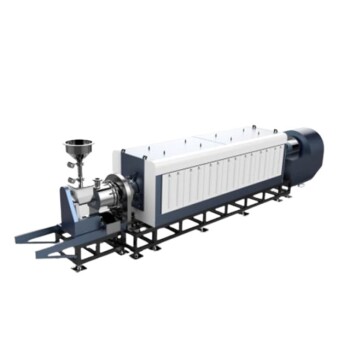
The role of an arc-melting furnace in this context is to synthesize specific uranium silicides, such as $U_3Si_2$, by fusing elemental uranium and silicon at high temperatures. This process achieves deep alloying, transforming raw elements into the precise chemical compounds required for high-quality composite nuclear fuels.
The arc-melting furnace is the foundational tool for establishing fuel chemistry. It converts elemental ingredients into stable fuel compounds while strictly managing the phase diagram to prevent material degradation.
The Mechanics of Synthesis
To understand the furnace's value, one must look beyond simple melting. The goal is precise chemical synthesis through thermal energy.
Deep Alloying
The furnace operates by subjecting elemental uranium and silicon to extreme temperatures. This is not merely mixing; it is a high-energy fusion process.
By melting these elements together, the furnace ensures they react completely. This achieves deep alloying, creating a homogenous material rather than a superficial mixture of ingredients.
Targeting Specific Compounds
The process is tuned to produce specific silicides, most notably $U_3Si_2$.
Achieving this specific stoichiometry is the primary definition of success for the synthesis stage. It provides the necessary baseline material for the subsequent fabrication of composite fuels.
Why Process Control is Critical
The primary reference highlights that temperature and time are not the only variables. Precise control of process parameters is essential to navigate complex phase diagrams.
Avoiding Brittle Phases
A major risk in this synthesis is the formation of brittle phases.
If the melting parameters drift, the resulting alloy may lack the necessary mechanical integrity. Minimizing these brittle structures is vital to ensuring the powder is robust enough for further processing.
Managing the U-Si-N System
The synthesis occurs within the context of the U-Si-N system.
Without strict control, there is a risk of forming unknown ternary phases (compounds containing three different elements). These unpredictable phases introduce impurities and inconsistencies that compromise the quality of the final fuel powder.
Common Pitfalls to Avoid
While the arc-melting furnace is a powerful tool, it requires rigorous oversight to avoid degrading the fuel quality.
Inconsistent Parameter Regulation
The most significant trade-off in this process is the narrow window of operation.
Failing to maintain precise control leads to material heterogeneity. This results in a powder that may be chemically impure or mechanically unsuitable for composite fabrication.
Unwanted Phase Formation
The presence of unknown ternary phases acts as a contaminant.
These phases dilute the effectiveness of the desired $U_3Si_2$ and can lead to unpredictable behavior in the reactor. Eliminating these through process control is a non-negotiable requirement.
Making the Right Choice for Your Goal
The arc-melting process is the gatekeeper of fuel quality. Your approach to operating the furnace determines the viability of the final product.
- If your primary focus is Fuel Purity: Prioritize parameter precision to eliminate unknown ternary phases within the U-Si-N system.
- If your primary focus is Mechanical Integrity: Ensure the process conditions specifically target the reduction of brittle phase formation to improve powder robustness.
The arc-melting furnace is not just a heat source; it is a precision instrument used to enforce chemical stability and exclude structural weaknesses from the fuel matrix.
Summary Table:
| Feature | Role in Uranium Silicide Synthesis | Impact on Nuclear Fuel Quality |
|---|---|---|
| Thermal Energy Source | High-energy fusion of elemental U and Si | Ensures deep alloying and chemical homogeneity |
| Stoichiometry Control | Targets specific compounds like $U_3Si_2$ | Establishes the precise chemical baseline for stable fuel |
| Phase Management | Navigates the complex U-Si-N phase diagram | Minimizes brittle structures and unwanted ternary phases |
| Parameter Regulation | Precise control of melting time and temperature | Prevents material heterogeneity and chemical impurities |
Elevate Your Nuclear Materials Research with KINTEK
Precise chemical synthesis requires more than just heat—it requires total control. KINTEK specializes in advanced laboratory equipment designed for the most demanding applications. Whether you are synthesizing high-density nuclear fuels or developing advanced alloys, our high-performance induction melting furnaces, vacuum furnaces, and crushing and milling systems provide the reliability you need to eliminate brittle phases and ensure material purity.
From high-temperature reactors to specialized ceramics and crucibles, our comprehensive portfolio supports every stage of your research. Partner with KINTEK to achieve the mechanical integrity and stoichiometry your projects demand.
Consult with our technical experts today to find the perfect solution for your lab.
参考文献
- Daniel de Souza Gomes. Uranium nitride and silicide composite fuels used to reduce fuel oxidation. DOI: 10.22533/at.ed.3174172421065
この記事は、以下の技術情報にも基づいています Kintek Solution ナレッジベース .