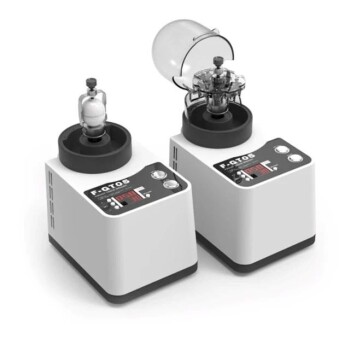
The primary function of a planetary ball mill during the preparation of Argyrodite solid electrolytes is to deliver intense mechanical energy that drives atomic-scale mixing and mechanochemical reactions. By subjecting raw materials like Li2S and P2S5 to high-energy impact and shear forces, the mill transforms separate powders into a homogeneous, high-purity precursor phase essential for achieving high ionic conductivity.
Core Insight: A planetary ball mill does far more than simply blend ingredients; it acts as a mechanochemical reactor. It utilizes kinetic energy to break chemical bonds and induce reactions at room temperature, creating a uniform, highly active precursor that is superior to what traditional physical mixing can achieve.
The Mechanics of High-Energy Milling
Delivering Mechanical Energy
The planetary ball mill operates by generating significant centrifugal and Coriolis forces. These forces slam grinding media (balls) against the raw material powders and the jar walls, transferring massive amounts of mechanical energy into the system.
Particle Refinement and Contact Area
This intense mechanical action pulverizes the raw materials, significantly reducing their particle size. This reduction creates a massive increase in the reaction contact area, which is critical for overcoming the diffusion limitations inherent in solid-state synthesis.
Achieving Atomic-Scale Homogeneity
Unlike standard mixing, which achieves uniformity only at the macroscopic level, planetary milling forces materials to mix at the atomic scale. This ensures that elements like Lithium, Phosphorus, and Sulfur are evenly distributed throughout the matrix before any heat treatment begins.
Driving Mechanochemical Reactions
Inducing Phase Transformation
The energy provided by the mill is sufficient to trigger mechanochemical reactions. Instead of remaining as a simple mixture of Li2S and P2S5, the materials begin to react and form new chemical bonds, effectively synthesizing the precursor structure during the milling process itself.
Creating Amorphous Precursors
This process often results in an amorphous (glassy) structure. By eliminating grain boundaries at this stage, the material becomes a highly active base, ready to convert into a pure crystalline phase during subsequent annealing or sintering steps.
Ensuring High Ionic Conductivity
The ultimate goal of this rigorous processing is conductivity. By guaranteeing a high-purity, homogeneous phase upfront, the mill prevents the formation of impurity phases that would otherwise block the movement of lithium ions in the final electrolyte.
Understanding the Trade-offs
Contamination Risks
The high-energy impact that drives the reaction also wears down the grinding media. There is a risk of introducing foreign impurities from the jar or balls (e.g., Zirconia or Alumina) into the electrolyte, which can degrade performance.
Thermal Management
The conversion of kinetic energy into heat can be significant. Excessive heat buildup inside the jar may trigger uncontrolled side reactions or degrade sensitive sulfide compounds, requiring careful control of milling speeds and pause intervals.
Structural Over-Milling
While amorphization is generally desired for precursors, excessive milling can sometimes damage the material structure or lead to aggregation. Finding the balance between sufficient reaction energy and over-processing is a critical process parameter.
Making the Right Choice for Your Goal
To optimize your Argyrodite preparation, align your milling parameters with your specific objectives:
- If your primary focus is ionic conductivity: Prioritize milling duration and energy intensity to ensure complete mechanochemical reaction and atomic-level homogeneity, minimizing blocking impurities.
- If your primary focus is process efficiency: Focus on utilizing the mill to maximize particle size reduction, which significantly shortens the time and temperature required for subsequent heat treatments.
The planetary ball mill is the gatekeeper of quality in solid electrolytes; its ability to homogenize at the atomic level directly dictates the performance ceiling of your final material.
Summary Table:
| Feature | Function in Argyrodite Preparation | Benefit to Final Material |
|---|---|---|
| Mechanical Energy | High-energy impact and shear forces | Drives mechanochemical reactions at room temp |
| Particle Refinement | Significant reduction in grain size | Increases reaction contact area and kinetics |
| Homogenization | Atomic-scale element distribution | Prevents impurity phases and enhances purity |
| Amorphization | Creation of active glassy structures | Lowers activation energy for final crystallization |
| Conductivity Gatekeeper | Eliminates ion-blocking barriers | Maximizes lithium-ion conductivity performance |
Elevate Your Solid-State Battery Research with KINTEK
Precision in the precursor stage defines the success of your Argyrodite electrolytes. At KINTEK, we specialize in the high-performance laboratory equipment required to achieve atomic-scale homogeneity. From our advanced planetary ball mills and specialized grinding media to our crushing and milling systems and sieving equipment, we provide the tools you need for superior material synthesis.
Whether you are refining battery powders or scaling up with our hydraulic presses, high-temperature furnaces, and high-pressure reactors, KINTEK is your partner in laboratory excellence.
Ready to optimize your electrolyte conductivity? Contact us today to discover how our comprehensive range of equipment and consumables can accelerate your research.
関連製品
- 高エネルギープラネタリーボールミル 実験室用水平タンク型粉砕機
- 高エネルギー全方向性プラネタリーボールミル粉砕機(実験室用)
- 実験室用プラネタリーボールミル 回転ボールミル
- 高エネルギー遊星ボールミル粉砕機(実験室用)
- 高エネルギープラネタリーボールミル(横型タンクタイプ)実験室用