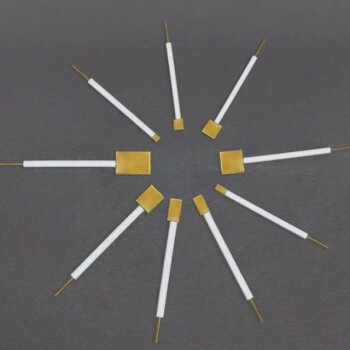
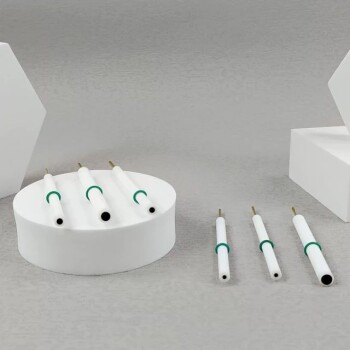
In acidic corrosion inhibition experiments, the Saturated Calomel Electrode (SCE) acts as a stable reference point for voltage measurement, while the salt bridge serves as a critical protective barrier. Together, they ensure that the electrical potential you measure is a result of the corrosion process, not an artifact of instrument drift or equipment damage.
Core Takeaway: The SCE provides the invariant voltage standard required to calculate corrosion rates, while the salt bridge preserves the accuracy of this standard by shielding the electrode’s internal chemistry from the harsh acidic test environment.
The Role of the Saturated Calomel Electrode (SCE)
Establishing a Stable Benchmark
In any electrochemical experiment, voltage is a relative measurement. You cannot measure the potential of your working electrode (the metal corroding) in isolation.
The SCE provides a constant, known potential. Because its internal potential does not change, any fluctuation you observe on the voltmeter can be attributed entirely to the corrosion processes occurring on your test sample.
Enabling Scientific Reproducibility
Without a stable reference like the SCE, your data would be subjective and impossible to compare with other studies.
The SCE allows for the precise determination of critical parameters, such as the corrosion potential ($E_{corr}$) and pitting breakdown potential ($E_b$). This standardization enables the scientific evaluation of how well an inhibitor actually protects materials like steel.
The Critical Functions of the Salt Bridge
Protection Against Contamination
Acidic solutions are aggressive and can easily contaminate the internal electrolyte of a reference electrode.
The salt bridge creates a physical separation between the test solution and the SCE. This prevents the acidic solution from contacting the SCE's internal electrolyte, which preserves the electrode's integrity and prevents sensor drift during the experiment.
Reducing Liquid Junction Potential
When two dissimilar solutions meet (like the test acid and the reference electrolyte), a voltage difference creates a "liquid junction potential" at the interface.
This extra voltage is an error source that distorts your data. The salt bridge minimizes this effect, ensuring that the voltage reading reflects the true electrochemical behavior of the sample rather than the interference between liquids.
Common Pitfalls and Trade-offs
The Risk of Bridge Clogging
While the salt bridge protects the electrode, the porous frit at the end of the bridge can become clogged by precipitates from the corrosion reaction.
If this pathway is blocked, the electrical circuit is interrupted, leading to noisy or unstable data. Regular inspection of the salt bridge tip is essential.
Introduction of Unwanted Ions
Ideally, a salt bridge is inert. However, strictly speaking, trace amounts of the bridge's electrolyte can leak into the test solution.
In extremely sensitive inhibition experiments, you must ensure that the ions within the salt bridge do not interact with the corrosion inhibitor you are testing, as this could skew the results.
Making the Right Choice for Your Goal
If your primary focus is Data Accuracy:
- Ensure the salt bridge is properly filled and free of bubbles to minimize liquid junction potential errors that distort voltage readings.
If your primary focus is Equipment Longevity:
- Prioritize the use of a salt bridge to isolate the SCE, as direct exposure to acidic environments will rapidly degrade the reference electrode and render it useless.
If your primary focus is Reproducibility:
- Calibrate the SCE against a master reference periodically to confirm it maintains the standard potential required for comparing $E_{corr}$ values across different experiments.
The reliability of your corrosion data is only as good as the stability of your reference system.
Summary Table:
| Component | Primary Function | Benefit to Experiment |
|---|---|---|
| SCE (Reference Electrode) | Provides a constant, known voltage standard | Allows precise calculation of corrosion rates and $E_{corr}$ |
| Salt Bridge | Creates a physical/ionic barrier | Protects SCE from acidic contamination and reduces junction potential error |
| Porous Frit | Maintains electrical continuity | Ensures stable data transmission while limiting fluid mixing |
| Internal Electrolyte | Defines the electrode potential | Facilitates scientific reproducibility across different studies |
Elevate Your Electrochemical Research with KINTEK
Accuracy in corrosion testing starts with high-quality instrumentation. KINTEK specializes in providing the precision tools research labs demand, including high-performance electrolytic cells, electrodes, and specialized laboratory equipment.
Whether you are studying corrosion inhibition or developing next-generation energy solutions, our comprehensive range of battery research tools, high-temperature furnaces, and premium consumables (PTFE, ceramics, crucibles) ensures your data remains reliable and reproducible.
Ready to upgrade your laboratory setup? Contact our technical experts today to find the perfect solution for your specific application requirements.
参考文献
- Magdy A. M. Ibrahim, B. Hammouti. Corrosion Inhibition of Carbon Steel by Imidazolium and Pyridinium Cations Ionic Liquids in Acidic Environment. DOI: 10.4152/pea.201106375
この記事は、以下の技術情報にも基づいています Kintek Solution ナレッジベース .